Être ou avoir ?
Être or Avoir? (How to Choose the Correct Verb)
In French, two very important verbs are “être” (to be) and “avoir” (to have).
Both verbs are used very often, but they are not interchangeable.
👉 Learning when to use être or avoir will help you build correct sentences in French.
When to Use Être
We use être to talk about:
Identity
Nationality
Profession
Description (adjectives)
Examples:
Je suis étudiant. (I am a student.)
Elle est française. (She is French.)
Nous sommes fatigués. (We are tired.)
💡 After être, we usually use an adjective or a noun (without an article for professions).
When to Use Avoir
We use avoir to talk about:
Possession
Age
Physical sensations
Some common expressions
Examples:
J’ai un livre. (I have a book.)
Il a 20 ans. (He is 20 years old.)
Nous avons faim. (We are hungry.)
Elle a froid. (She is cold.)
⚠️ In French, we use avoir for age and physical feelings — not être.
Common Mistakes
❌ Je suis 20 ans.
✔️ J’ai 20 ans.
❌ Je suis faim.
✔️ J’ai faim.
⚠️ Remember
Age → avoir
Hunger / thirst / cold / heat → avoir
Nationality / profession / description → être
Fiche récapitulative
Le verbe être
Pour indiquer :
Sa profession
Sa nationalité
Se décrire physiquement (grand, jeune, blond, ...)
Se décrire moralement (timide, jovial, dynamique, ...)
Son état matrimonial (marié, célibataire, ...)
Le verbe avoir
Pour indiquer :
Ce que l’on possède (voiture, chien, ...)
Son âge
Une précision sur une partie du corps (yeux bleus, cheveux bruns, ...)
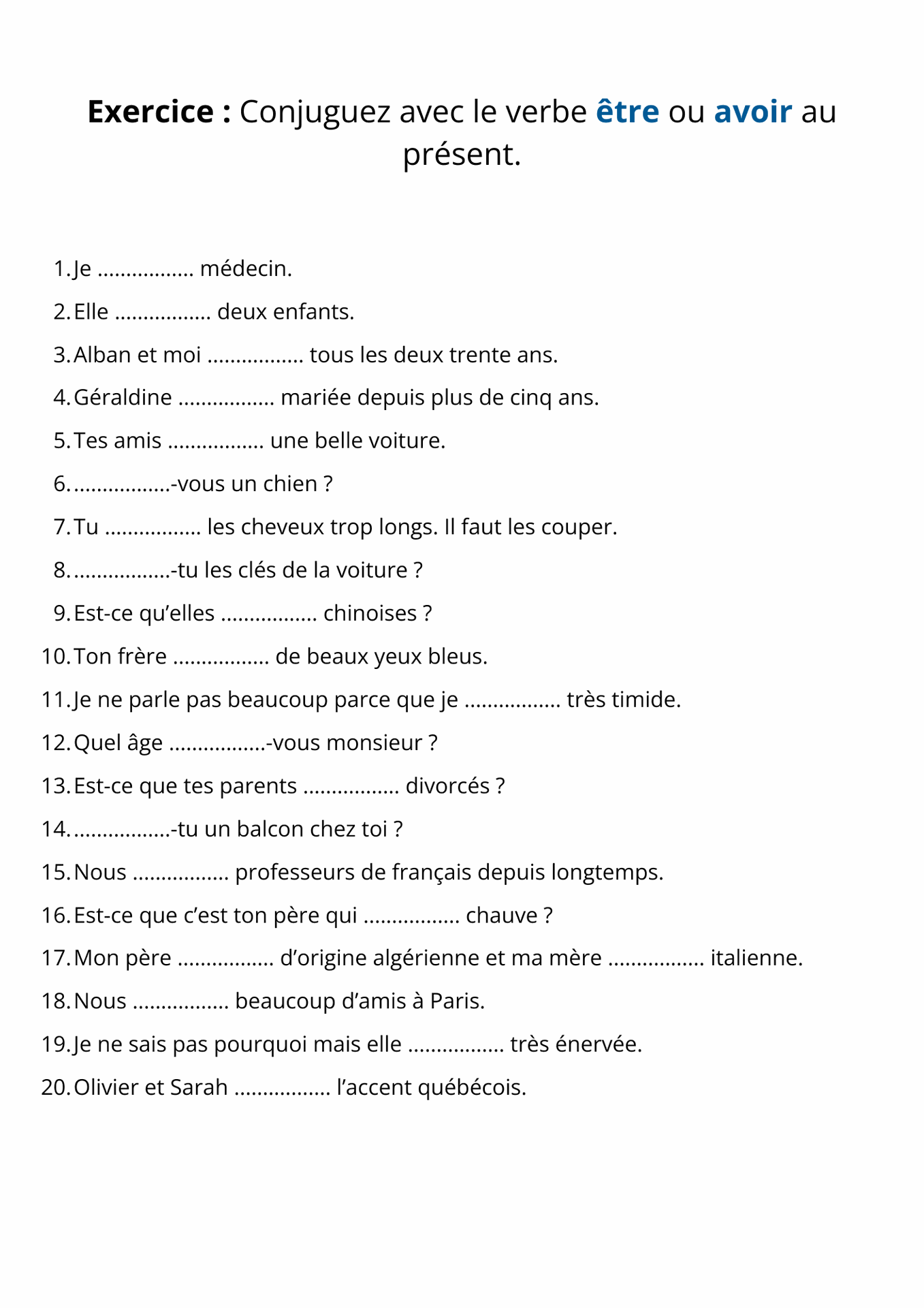
Practice Time
In the following exercises, choose the correct verb: être or avoir.
Read each sentence carefully and select the correct form.
💡 This activity will help you avoid common mistakes and speak French more confidently.