Skip to Content
Les verbes du premier groupe en -eler / -eter
Verbs Ending in -ELER and -ETER
In French, some verbs end in -ELER or -ETER, such as appeler (to call) or jeter (to throw).
These verbs belong to the first group, but they have a small spelling change in certain forms of the present tense to keep the correct pronunciation.
They are very common in everyday French, so it is important to know how to conjugate them correctly.
👉 These verbs follow regular first-group endings, but the stem may change slightly.
Present Tense
To conjugate -ELER and -ETER verbs in the present tense:
Remove the -ER ending from the infinitive.
Add the regular present tense endings:
Je
Tu
Il / Elle
Nous
Vous
Ils / Elles
-elle
-elles
-elle
-ons
-ez
-ellent

⚠️ However, in some forms, the consonant l or t is doubled to keep the correct sound.
Examples :
Appeler (to call) Jeter (to throw)
J’appelle Je jette
Tu appelles Tu jettes
Il/Elle appelle Il/Elle jette
Nous appelons Nous jetons
Vous appelez Vous jetez
Ils/Elles appellent Ils/Elles jettent
💡 Notice:
The consonant is doubled in the forms je, tu, il/elle, ils/elles.
In the nous and vous forms, the stem keeps a single l or t.
⚠️ Remember
These verbs use regular first-group endings.
The consonant l or t doubles in some forms to maintain pronunciation.
The nous and vous forms do not double the consonant.
Practice Time
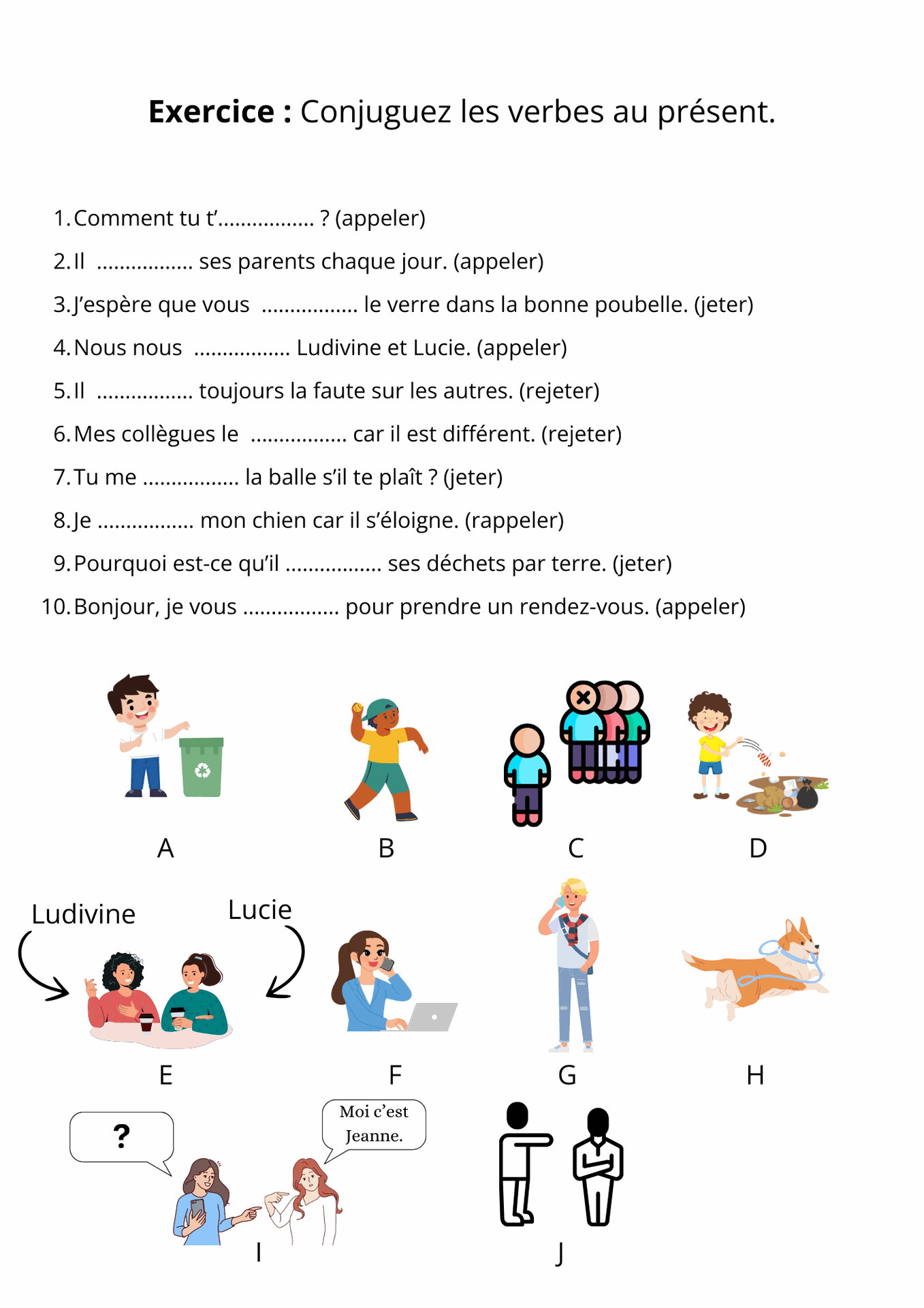
In the exercises that follow, practise conjugating different -ELER and -ETER verbs in the present tense.
Read each sentence carefully and write the correct form of the verb.
💡 Regular practice will help you conjugate these verbs easily and speak French confidently.